
Bills, Blackouts, and Broken Trust: The 5 Biggest Consumer Concerns About the Future of Energy
Updated: Aug 13
Modernization Means Nothing if Energy Bills Keep Rising
Why Consumers are Losing Trust in the Future of Energy
For years, the future of energy has been framed like a strategy deck. It was about modernization, decarbonization, grid transformation, and innovation roadmaps. But that's not how most consumers experience it day to day. They experience it through rate increases, a long outage, a confusing rebate page, or the creeping feeling that the system is getting more expensive without any future relief. That's why this moment feels different. The Smart Energy Consumer Collaborative's (SECC) 2026 State of the Consumer report says affordability is now the top priority across every customer segment, with reliability and resilience close behind. Additionally, the American Customer Satisfaction Index (ACSI) is seeing the same tension from another angle, saying rising demand, infrastructure investment needs, affordability pressure, and higher expectations are all colliding at once. In simple terms, the future of energy has entered its cost-and-trust phase. Below are the top 5 concerns facing consumers as energy evolves.
#1. Energy Affordability is Now the Filter for Everything Else
Every future-energy idea now has to pass the kitchen-table test. JD Power says the average monthly household utility bill in 2025 hit $189 for electricity, $122 for gas, and $101 for water. It also found that 22% of customers either could not pay their full bill or already carried an outstanding balance. That's not a niche problem. That's a broad affordability warning sign. If the bill already feels unmanageable, even smart investments can start to feel like someone else’s agenda.
As a result, the question of who pays is getting louder. Reuters reports that policymakers are actively weighing whether data centers should have to bring more of their own power to the table rather than pushing the cost of grid expansion onto residential customers.
#2. Grid Reliability Matters More than the Talking Points
After affordability, the next question is brutally simple. Will the power stay on when people need it most? JD Power reports that 55% of utility customers experienced a power outage in 2025, and 47% of those outages were linked to extreme weather. The SECC’s research lands in the same place, showing that reliability and resilience remain near the top of what customers care about. In essence, consumers do not care how modern the grid sounds if it still fails like an old appliance at the worst possible moment.
Live tensions are making that anxiety sharper, but they also point to a path forward. Reuters reported in March that large tech users and utilities are testing flexible demand arrangements to reduce peak stress. At the same time, the U.S. Department of Energy (DOE) announced an approximately $1.9 billion funding opportunity for grid upgrades aimed at meeting rising demand while lowering electricity costs and improving reliability.
While consumers don't expect a perfect grid, they do need evidence that utilities are building a sturdier one. Fortunately, recent developments seem to be trending in that direction.
Higher costs alone do not explain the current state of concern. Understandably, customers also want to know why costs are rising and whether the process is fair. JD Power found that 37% of customers at utilities with strong brand appeal trust their provider to set fair rates, compared with just 10% at utilities with weak brand appeal. The same JD Power report says 16% of electric utility customers believe AI and data centers played a role in increasing their bills over the past year. That matters because when communication is vague, customers fill in the blanks themselves. And those assumptions are not always generous. If utilities don't explain the why behind rising costs, speculation and resentment take over.
Furthermore, that distrust is no longer staying inside billing departments or customer service queues. The Associated Press reported this month that rising electricity bills and controversy around data centers are drawing unusual attention to utility elections in states such as Arizona and Alabama. In other words, frustration about price, fairness, and future load growth is starting to spill into governance.
#4. Utility Digital Experience Can Either Reduce Stress or Multiply it
Digital service used to be a convenience layer. Now it's part of the utility product itself. JD Power’s 2026 Utility Digital Experience Study found that 28% of utilities profiled still don't offer a mobile app. It also found the biggest performance gaps in viewing outages, reporting outages or leaks, and changing pricing plans. On top of that, pricing plans, rebate information, and current outage information remain some of the hardest things for customers to find across digital channels.
This is significant because the digital space is now where customers go first when they are confused, inconvenienced, or worried. JD Power says mobile apps generate the highest satisfaction, yet many utilities still force customers into non-intuitive desktop and mobile web experiences. A difficult utility website is like a hospital with no front desk. Even basic questions start to feel urgent. As rates become more dynamic and outage conditions more volatile, poor digital self-service doesn't just frustrate customers. It amplifies stress across billing, reliability, and trust.
#5. Consumers Need Energy Change to Feel Practical, Not Theoretical
There is still room for optimism, but it's conditional. The SECC says consumers will participate in the clean energy transition if it's easy and affordable. The ACSI similarly points to an expectation gap, where participation in programs does not automatically translate into higher satisfaction if people do not feel a clear benefit. In simple terms, consumers will support new tools when those tools solve real problems without adding new friction.
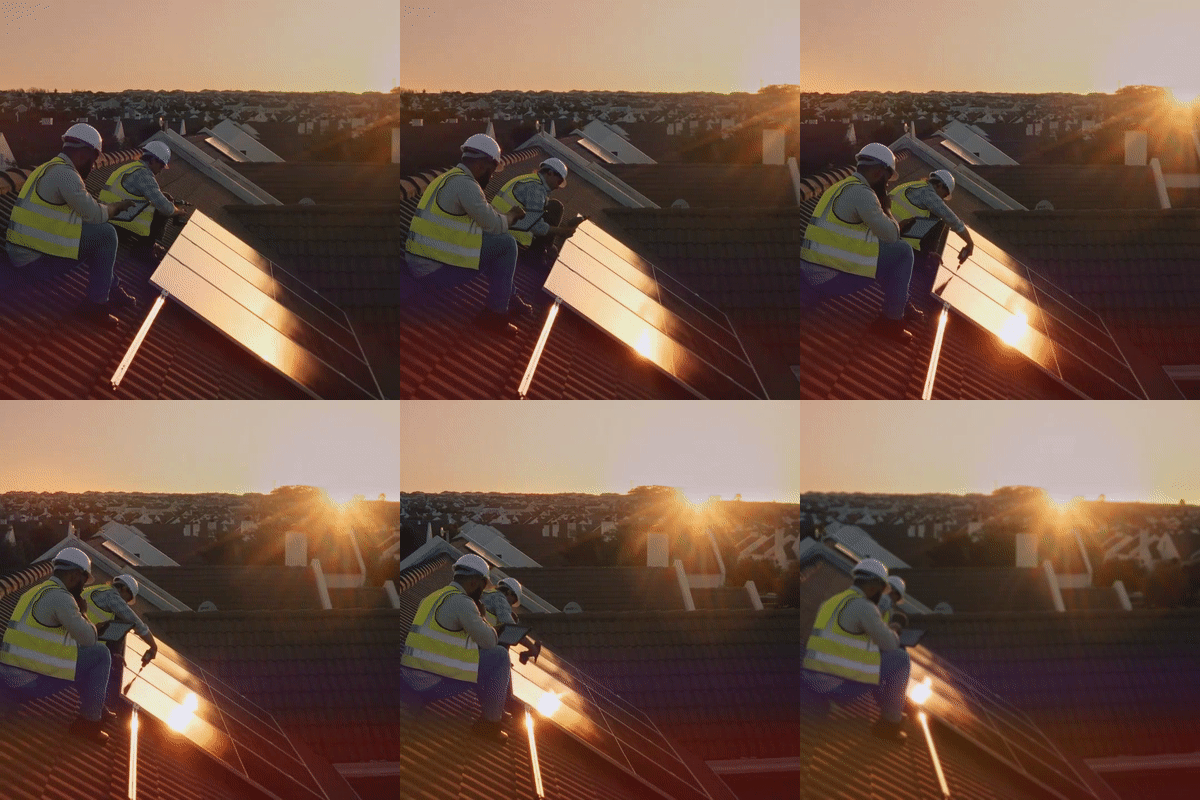
Puerto Rico offers one of the clearest real-world examples of what that looks like. The International Energy Agency (IEA) reported in April that rooftop solar capacity there reached 1,456 MW by the end of 2025, or 20% of the territory’s total capacity mix. Between 2016 and 2025, rooftop solar installations accounted for 81% of new generating capacity. The growth came as Puerto Rico dealt with frequent outages and reliability challenges, which helps explain the adoption story. People embraced new energy tools because those tools addressed an immediate lived need. By contrast, the Associated Press reported that booming data center demand is making it harder for some states and utilities to stay on track with clean-energy goals, intensifying fights over fossil dependence, reliability, and who should pay.
The future gains traction when it feels helpful.
It gets resisted when it feels like one more burden.
The Real Story is Friction, Risk, and Visible Value
Put these five concerns together and one story emerges. High bills weaken trust. Weak trust makes outage communication less credible. Poor digital tools make information harder to access. And when new energy programs feel confusing or costly, progress starts to look like risk. Consumers are not asking for a more impressive strategy narrative. They are asking for lower friction, lower risk, and more visible value in daily life.
That's exactly why this moment is bigger than messaging. It's an execution challenge, one our experts are well-versed in. Tamazari is a transformation and execution partner serving leaders in energy, fleet, and infrastructure. We help turn strategy into measurable impact while keeping teams aligned, systems stable, and initiatives on track.
That's the gap utilities have to close right now. You can dream big about modernization, resilience, and customer trust all day long. Consumers only feel progress when the work actually lands.
Learn more about us and our approach to modernization.
About Tamazari
Tamazari is a Washington-based technology modernization and execution consultancy serving utilities, fleet operators, public agencies and critical infrastructure organizations across the U.S. Our work spans energy IT, SCADA, GIS, ERP/SAP, enterprise modernization, telecom infrastructure, data centers and fleet telematics.
Footnotes
https://smartenergycc.org/2026-state-of-the-consumer-report/
https://smartenergycc.org/research-release-2026-state-of-the-consumer/
https://www.jdpower.com/business/resources/average-household-utility-costs-rise-7-2025
https://www.jdpower.com/business/resources/utilities-outlook-2026
https://www.jdpower.com/business/press-releases/2026-us-utility-digital-experience-study
https://www.jdpower.com/business/press-releases/2024-us-utility-digital-experience-study
https://apnews.com/article/47d1b6633ed720962848f4b5b91e7d6b
