
The “Plug-In Solar” Moment Is Here, and One Safety Standard Is About to Make It Mainstream
Updated: Aug 13
UL 3700 is the behind-the-scenes rulebook that turns balcony solar from a risky gray area into a scalable, utility-friendly product
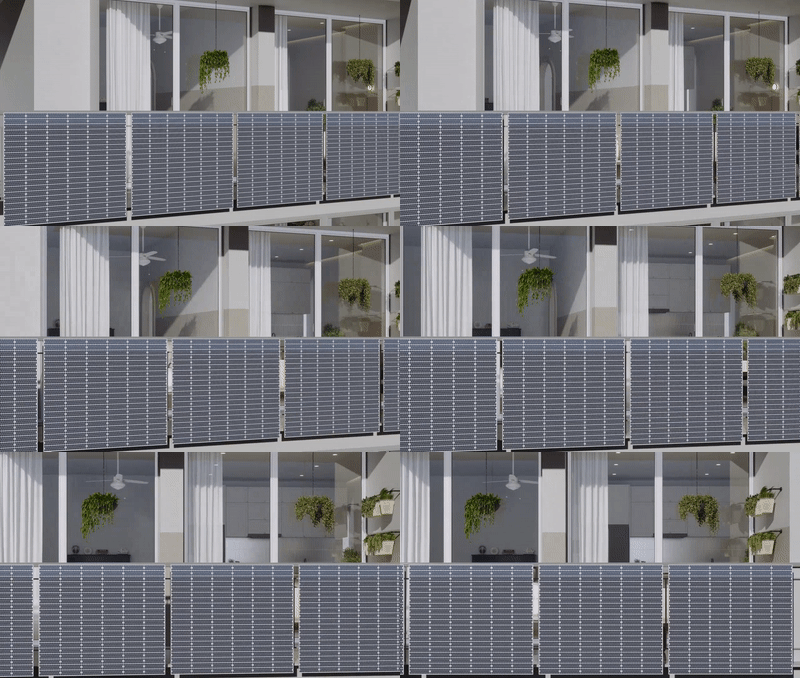
Why can you plug in a space heater, but not a solar panel?
Balcony solar sounds like a simple “hang it, plug it in, save money” idea. The truth is more complex. This article uncovers why UL 3700 can turn plug-in solar from a clever hack into a trusted mass-market product.
But first, here are a few key definitions that matter to understand what's going on:
UL is the safety science organization many industries lean on for standards, testing, and certification.
UL Solutions is the arm that runs product testing and certification programs.
UL 3700 outlines the criteria that set construction, performance, and labeling for interactive plug-in PV equipment and systems. UL’s new certification program is explicitly based on UL 3700, and it’s designed for plug-in solar systems at scale.[1]
If you want a quick analogy, UL is the referee, and UL 3700 is the rulebook that turns plug-in solar from “DIY electrical territory” into “appliance-like.”
Plug-in solar for renters is really an access story
Now that you understand what UL 3700 means, let's explore how solar power has been treated in the United States up until this pivotal point. Rooftop solar has done incredible work, but it’s structurally biased toward people who control a roof. In the U.S., the homeownership rate sits around 65.7%, which means a very real share of households are renters.[2] Even among owners, plenty of homes are effectively “solar locked,” because of shading, roof age, HOA restrictions, condo setups, etc. Additionally, some homeowners simply don't want the stress of taking on a large construction project. In contrast, plug-in solar, often called balcony solar, is basically a clean-energy on-ramp for everyone who’s been watching the energy transition from the sidelines. In simple terms, it’s solar that behaves more like a consumer product than a construction project.
Why UL 3700 is the quiet “mainstreaming mechanism”
Most of us have been trained to think of outlets as the end of the line. You plug something in, it consumes power, and your home wiring behaves like a one-way street. Plug-in solar flips that model. The moment a panel starts sending electricity back into your home through an outlet, your wiring starts acting like a two-way street. And that is exactly where this category has historically gotten stuck, not on “does it generate power,” but on “can we make this safe and predictable enough to scale?”[3]
That’s why the real plug-in solar breakthrough is not the panel. It’s the safety infrastructure that makes the whole thing trustworthy at appliance scale. In early 2026, UL Solutions debuted a dedicated testing and certification framework for plug-in photovoltaic systems, built around UL 3700.[1] The goal is simple: give manufacturers, regulators, retailers, and utilities a shared safety baseline so this doesn’t turn into a wild-west scenario.
This is important because when you widen access, the societal impact gets bigger. In essence, you’re not just decarbonizing, you’re democratizing.
The hidden electrical constraints utilities are worried about
Utilities and inspectors get painted as the villains in plug-in solar debates, but the technical concern is real. Branch circuits were designed for one-way power flow, from the panelboard out to the loads. When a plug-in PV system backfeeds power into the same circuit, the combined current from the utility and the PV source can exceed conductor ratings without tripping the circuit breaker in the way a consumer intuitively expects. That undetected overload risk is a genuine fire and shock hazard if it’s not accounted for. As a result, UL 3700 matters because it gives everyone a way to move from opinion to engineering. It’s a path to safer designs, clearer labeling, and more consistent permitting logic, which ultimately creates the conditions for responsible adoption.

Germany already proved the demand for solar is real
If you want to understand where this is going, look at Germany’s balcony solar boom. By mid-2025, registrations were around the one-million mark, with hundreds of thousands added in a short window as policy and product norms made adoption frictionless. That’s not a niche hobby. That’s a consumer movement. The lesson for the U.S. is not to copy Germany exactly. The lesson is that when the product is simple, affordable, and trusted, everyday people will show up for climate action without needing to become energy experts.
U.S. policy is starting to catch up, fast
In the U.S., the legislative conversation is shifting from “is plug-in solar allowed” to “under what conditions is it allowed.” News coverage has highlighted Utah as an early mover with plug-and-play rules for smaller systems, and multiple states have introduced or considered bills aimed at clarifying permitting and interconnection expectations.[5]
That policy wave creates urgency for standards. Without a shared safety reference point, lawmakers risk writing rules that are either too lax and invite incidents, or too strict and kill adoption. UL 3700 is the kind of technical anchor that helps avoid both failure modes.
This is a pivotal moment because plug-in solar lives or dies on public trust. A handful of incidents from non-compliant products, confusing guidance, or sloppy installs can trigger backlash, restrictive policy, and blanket bans. UL’s own writing on plug-in PV safety issues reads like a preview of exactly what can go wrong if the market outruns guardrails. In essence, UL 3700 is not just technical paperwork. It’s reputation-saving insurance for the entire category.
Why utilities should operationalize balcony solar
Utilities need to start treating it like an inevitable customer behavior they can shape. Furthermore, there’s an important resilience storyline here that deserves more attention. People are living through more disruptive weather and more costly disasters. NOAA counted 27 billion-dollar weather and climate disasters in the U.S. in 2024.[6] And national lab analysis shows weather-related outages have been rising significantly over the past couple decades.[7]
Plug-in solar on its own is not a whole-home backup solution, but UL notes scenarios where plug-in systems can support essential devices during outages. Pairing safe plug-in PV with small storage over time could become a very practical resilience tool for apartments and multifamily buildings that are otherwise stuck.
The real story is “solar becomes an appliance”
When clean energy becomes easy, people participate. When it feels risky or complicated, adoption stalls. UL 3700 is one of those quiet infrastructure moments that makes the energy transition feel less like a specialist project and more like normal life. It’s how balcony solar stops being a clever hack and starts being a product category you can buy, insure, permit, and operate with confidence.
And if you’re a utility, manufacturer, or public agency trying to ride this wave without creating new risk, the work ahead is not mainly hardware. It's systems work that includes: standards adoption, customer operations, grid-facing processes, risk management, and program delivery. That’s where execution partners like Tamazari show up best—in the “handle the how” layer that turns innovation into outcomes.
Learn more about our modernization services and recent projects.
About Tamazari
Tamazari is a Washington-based technology modernization and execution consultancy serving utilities, fleet operators, public agencies and critical infrastructure organizations across the U.S. Our work spans energy IT, SCADA, GIS, ERP/SAP, enterprise modernization, telecom infrastructure, data centers and fleet telematics.
Footnotes
[1] UL Solutions press release on launching a testing and certification framework for plug-in solar based on UL 3700.
[2] Homeownership rate data (Q4 2025 shown as 65.7%).
[3] UL Solutions overview of overcurrent protection challenges and backfeed risk in plug-in PV systems.
[4] U.S. policy momentum and state-level consideration of plug-in solar.
[5] NOAA Billion-Dollar Weather and Climate Disasters, 2024 count.
[6] NREL analysis noting substantial increases in weather-related power outages over time.
