
Clean Energy Programs Are Stress-Testing Utility Billing Systems
Updated: Aug 13
How Time-of-Use Rates, EV Tariffs, and Net Billing are Exposing CIS Limitations
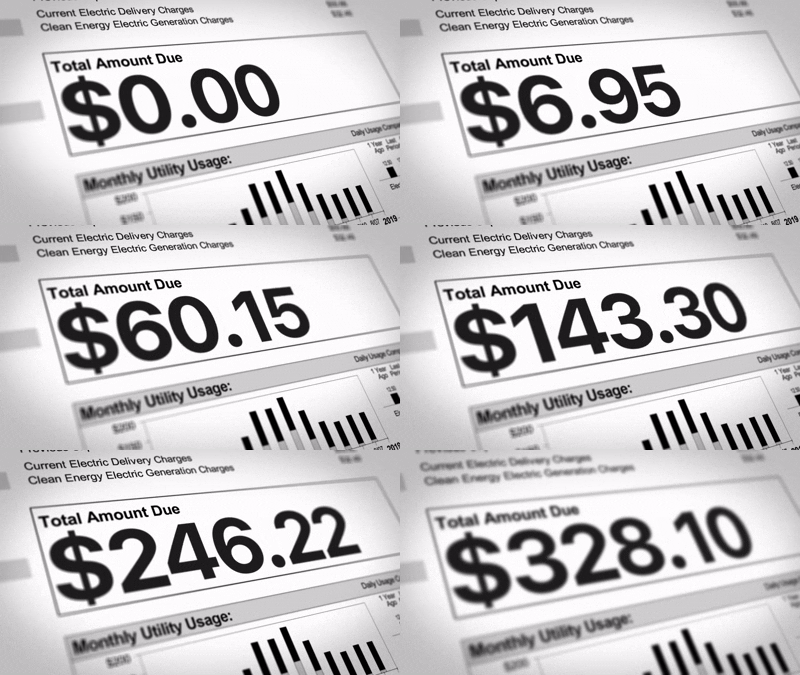
The Silent Operational Risk Utilities Didn’t Plan For
Clean energy is working—at least on the surface. Time-of-use rates are expanding. EV tariffs are filling up faster than forecasts predicted. Net billing has replaced simpler net metering in many regions. Not to mention, community solar subscriptions are scaling at record speed. From the outside, it looks like momentum.
But behind the scenes, many utilities are discovering an uncomfortable truth: The systems responsible for turning all of that innovation into an accurate customer bill were never designed for this level of complexity.
The Clean Energy Success Story—And the Part No One Talks About
Every clean energy program eventually lands in one place: the customer bill. And that bill has to reconcile usage, exports, incentives, credits, exemptions, and regulatory rules—accurately, consistently, and at scale. When it doesn’t, the consequences ripple far beyond the billing department.
Most legacy CIS platforms were engineered with a remarkably simple worldview. One customer. One meter. One tariff. One monthly bill.
That architecture assumed static rates, predictable consumption patterns, and limited exceptions. For decades, it worked. Billing was stable, auditable, and largely invisible—which is exactly how utilities wanted it.
These systems were not designed for conditional logic layered on top of conditional logic. Nor were they built to dynamically reconcile exports and imports across time windows, apply stacked incentives from multiple agencies, or handle retroactive adjustments without human intervention.
Clean energy didn’t just stretch billing systems. It broke the core assumptions of their foundation.
How Clean Energy Programs Multiply Billing Complexity
Modern programs don’t add complexity in neat, incremental steps. They multiply it.
A single customer may now have multiple meters, behind-the-meter generation, EV charging loads, and export credits that vary by time of day. Add in community solar allocations or income-qualified discounts, and suddenly the bill is the output of dozens of decision paths.
Industry research shows that utilities with advanced rate designs see two to three times more billing errors than those with flat rates. That’s because every exception adds another rule the system has to follow—and it has to work perfectly, every billing cycle, at massive scale.
That’s where cracks start to form.

The Silent Failure Mode: Manual Workarounds at Scale
When billing systems can’t natively support a new rate or incentive, teams adapt. Spreadsheets appear. Shadow systems emerge. Exception handling becomes routine.
At first, this feels manageable. Errors are corrected after bills go out. Adjustments are made quietly. Customers are reassured.
But those manual processes don’t scale. A reconciliation that takes ten minutes per account becomes unmanageable at ten thousand accounts. Audit trails weaken. Knowledge concentrates in a handful of experienced staff, and as a result, risk compounds silently.
By the time customers notice—or regulators ask questions—the exposure is already material.
Why Billing Fragility Becomes a Financial and Reliability Risk
Even small discrepancies, when multiplied across large populations, can translate into millions of dollars in under- or over-collection. Regulatory penalties for inaccurate billing can be severe, especially when tied to low-income or incentive-driven programs. And customer trust, once damaged, is expensive to rebuild.
Recent utility filings show that billing-related complaints spike dramatically after rate changes tied to clean energy programs, often increasing call center volume by 15–25% in the first few cycles. Those calls are symptoms of deeper system strain, not customer confusion.

What Forward-Thinking Utilities are Doing Differently
Some utilities are starting to flip the script.
They stress-test billing impacts before programs launch. They bring billing and CIS teams into policy design conversations early. They design programs around system constraints—not idealized assumptions. And they invest in modernization that prioritizes flexibility, governance, and long-term scalability.
In these organizations, billing isn’t an afterthought. It’s treated as a clean energy enabler.
The Bigger Lesson Hiding in Plain Sight
Grid modernization isn’t just about wires, meters, or software platforms. The customer bill is the final expression of every clean energy initiative. If the bill is wrong, nothing else matters.
That’s where our experts focus their work. With deep experience modernizing utility systems—from CIS and ERP to program integration and change management—Tamazari helps utilities connect policy ambition to operational reality. Not by ripping and replacing overnight, but by aligning systems, people, and governance so modernization actually sticks.
Because clean energy rarely fails all at once. It fails quietly—until billing makes the cracks visible.
Learn more about our modernization services and recent projects.
About Tamazari
Tamazari is a Washington-based technology modernization and execution consultancy serving utilities, fleet operators, public agencies and critical infrastructure organizations across the U.S. Our work spans energy IT, SCADA, GIS, ERP/SAP, enterprise modernization, telecom infrastructure, data centers and fleet telematics.
