
Why Innovative Transmission Tower Design Could Be the Key to Faster Grid Expansion
Updated: Jul 31
In the Race to Modernize the Grid, Perception is Becoming Part of Performance
Why Transmission Tower Design is a Grid Modernization Issue
The biggest barrier to building more transmission isn't always the steel, the permitting, or even the cost. Sometimes it's the moment a community looks up and decides the project doesn't belong there. That's the blind spot in a lot of grid planning. We talk about transmission as an engineering challenge, but in practice it's also a design challenge. And the more infrastructure the U.S. needs to build, the harder that truth is to ignore.
The North American Electric Reliability Corporation (NERC) said this year that summer peak demand across North America is now forecast to grow by 224 gigawatts over the next decade, with new data centers and the digital economy driving most of that increase. At the same time, the Department of Energy's (DOE) National Transmission Planning Study found that the lowest-cost future grid would require the total U.S. transmission system to grow to 2.1 to 2.6 times its 2020 size by 2050. Furthermore, a recent grid strategies review found the U.S. built 888 miles of new 345-kV-and-above transmission in 2024, up from 322 miles in 2023. Yet, this is still far below the roughly 5,000 miles per year of high-capacity regional transmission suggested by DOE’s planning analysis. In simple terms, the country is heading into an era of much more visible grid infrastructure. [1][2][3]
Redefining Transmission Tower Design
Visual acceptance matters, and this concept is not lost on forward-thinking utilities. A USDA Forest Service paper on utility aesthetics highlighted how American Electric Power (AEP) invested in BOLD transmission design partly to anticipate right-of-way acquisition issues and public opposition. BOLD stands for Breakthrough Overhead Line Design. It's AEP’s compact transmission-line design that uses a tighter conductor arrangement and curved steel arms to move more power with shorter, lower-profile structures.
That same paper notes that the BOLD approach reduced required right-of-way, cut tower height, and delivered more capacity in the same corridor. In this instance, design was not treated as decoration. It was treated as buildability. [9] That distinction matters. We often talk about siting as if it lives entirely inside permitting. In reality, siting also lives inside perception, trust, and local identity. If a project shows up looking like permanent scaffolding dropped into someone’s everyday landscape, the community response is going to reflect that. If it shows up looking more intentional, more compact, and better fitted to place, the conversation changes before the first public meeting even starts.
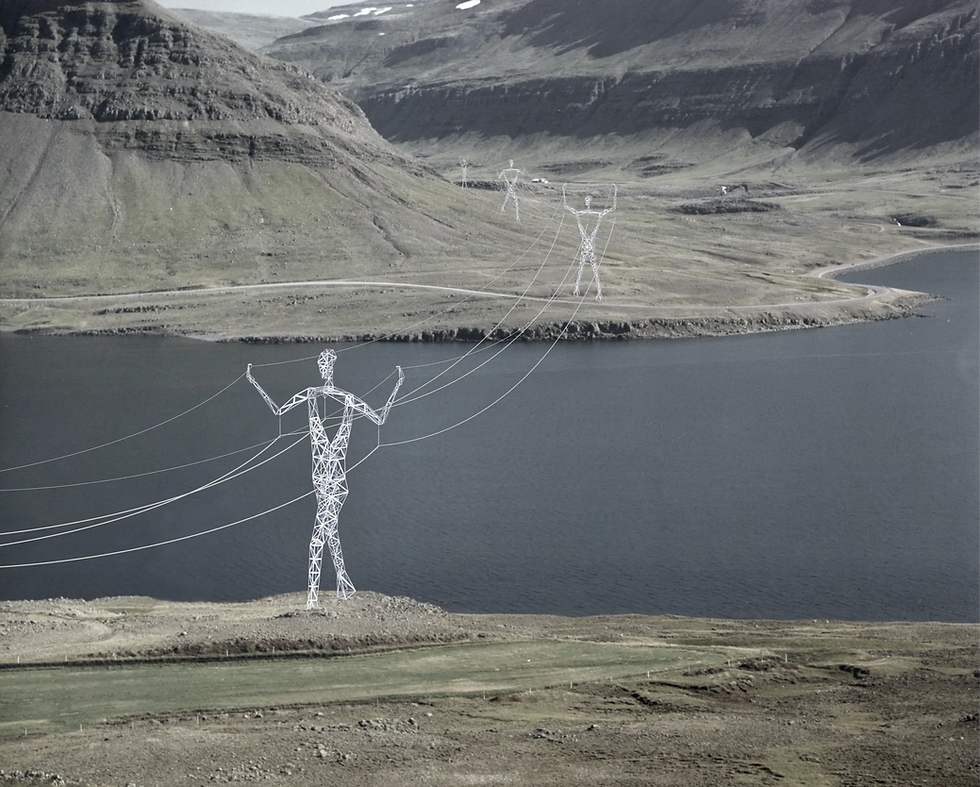
Choi+Shine’s “Land of Giants” project goes one step further, even as an unbuilt concept. The proposal transforms conventional pylons into human-like figures by making relatively minor alterations to established steel-framed tower design. The architects describe them as monuments in the landscape rather than purely functional objects, and the concept explicitly aims to create a sense of place. [10] (choishine.com)
This project highlights the fact that transmission structures are not visually neutral and teaches an important lesson. If utilities are going to shape a landscape, they should stop pretending aesthetics are outside the project boundary.
How Utilities Can Make Transmission Projects More Buildable
So what should utilities and grid planners do with this? First, they should move visual acceptance upstream. If cost, reliability, schedule, and safety are tracked in the business case from day one, visual acceptance risk should be too. That means viewshed analysis, design alternatives, and visual simulations before routes harden.
Second, they should treat design as part of long-term planning, not as a late-stage communications exercise. The Federal Energy Regulatory Commission's (FERC) Order No. 1920 pushes transmission providers toward longer-horizon regional planning, including at least 20-year planning windows and repeated planning cycles. That creates a better timeline for buildability thinking, especially when utilities need to weigh corridor fit, state engagement, and cost allocation over time. [13]
Third, they should stop separating aesthetics from engineering. The strongest examples are doing both at once. Smaller footprints, lower visual contrast, shorter structures, better materials, and context-aware placement can reduce conflict while still improving capacity, and reliability. If we can't turn transmission towers into works of art like Choi+Shine’s example under today's constraints, at the very least utilities can make them easier to live with.
Scaling Transmission Tower Redesign From Concept to Practice
In an ideal world, all transmission towers would look like Choi+Shine's example. The question is how transmission design moves from striking concept to repeatable standard.
A powerful example comes from France. Réseau de Transport d'Électricité, France’s electricity transmission system operator, launched a 2023 competition for the design and supply of a new generation of pylons, with the goal of turning a fresh design language into an industrialized five-year market for at least 1,000 pylons. That's what makes the idea strategically important. It's not design as spectacle. It's design as a procurement strategy. That distinction matters in the U.S., where transmission innovation too often gets trapped between pilot thinking and regulatory inertia. If a redesign effort is going to matter here, it needs a sponsor with real procurement power behind it. In practice, that means a major utility, a multi-state coalition, or a DOE-backed initiative willing to translate a winning concept into an approved family of structures rather than a one-off landmark. The point is not to create bespoke art for every corridor. The point is to create two or three compliant archetypes that can be specified repeatedly, fabricated at scale, maintained safely, and explained clearly to communities before opposition hardens. In simple terms, standard options make design legible to both the supply chain and the public.
Just as important, a U.S. version needs a governance home. FERC’s Order No. 1920 was designed to improve long-term regional transmission planning and cost allocation, and it requires transmission providers to use at least a 20-year planning horizon, develop multiple long-term scenarios, and reassess them at least every five years. It also expands the role of states in planning and cost allocation decisions. That makes Order No. 1920 more than a planning reform. It creates a more credible place to justify acceptance-risk mitigation as part of a long-horizon transmission strategy, rather than treating visual design as an afterthought outside the core business case. The next step is connecting design ambition to delivery discipline.
Grid Modernization Needs Design Thinking and Delivery Discipline
The next transmission era will not be won by modeling alone. It will be won by combining technical performance with public durability. The grid needs more lines. The public needs more reason to live with them. Those are not competing truths. They are now part of the same assignment. That is why transmission design deserves a serious seat inside modernization strategy. And that is also why execution matters so much. It takes real program governance, planning integration, stakeholder alignment, and delivery discipline to turn a big idea into something that actually gets built. That is the kind of gap Tamazari is built to close.
Footnotes
[1] U.S. Department of Energy, National Transmission Planning Study, Chapter 6https://www.energy.gov/sites/default/files/2024-10/NationalTransmissionPlanningStudy-Chapter6.pdf
[2] U.S. Department of Energy, National Transmission Planning Study webinar transcripthttps://www.energy.gov/sites/default/files/2024-11/DOE_GDO_October%2016%20NTP%20Study%20Webinar_Transcript.pdf
[3] NERC, February 2026 bulletin citing the 2025 Long-Term Reliability Assessmenthttps://www.nerc.com/globalassets/who-we-are/news/2026/02/2026_2_2_standardscompliancebulletin.pdf
[4] Grid Strategies, Power Demand Forecasts Revised Up, 2025https://gridstrategiesllc.com/wp-content/uploads/Grid-Strategies-National-Load-Growth-Report-2025.pdf
[5] IEA, Electricity Grids and Secure Energy Transitions, Executive Summaryhttps://www.iea.org/reports/electricity-grids-and-secure-energy-transitions/executive-summary
[6] IEA, Building the Future Transmission Grid, 2025https://iea.blob.core.windows.net/assets/6fbf940a-d4e8-4156-b8e0-07c2f793c094/BuildingtheFutureTransmissionGrid.pdf
[7] U.S. Department of Energy, Harry Allen–Mead 500 kV Transmission Line Project Environmental Assessmenthttps://www.energy.gov/documents/ea-1470-fea-2004pdf
[8] Bureau of Land Management, Technical Note 446, The Use of Color for Camouflage Concealment of Facilitieshttps://www.blm.gov/sites/default/files/documents/files/Library_BLMTechnicalNote446.pdf
[9] USDA Forest Service, Reclaiming Visual Stewardship in Tucson, Arizonahttps://www.fs.usda.gov/nrs/pubs/gtr/gtr-nrs-p-183papers/21-alster-VRS-gtr-p-183.pdf
[10] Choi+Shine Architects, The Land of Giantshttps://choishine.com/Giants.html
[11] UK Government, Community Benefits for Electricity Transmission Network Infrastructurehttps://assets.publishing.service.gov.uk/media/65f89eeaca3670001a13a348/community-benefits-electricity-transmission-network-infrastructure.pdf
[12] RIBA, Pylon Design Competition and T-pylon deployment updatehttps://www.riba.org/explore/competitions/pylon-design/
[13] FERC, Order No. 1920 explainer and staff presentationhttps://www.ferc.gov/office-public-participation-2024-annual-reporthttps://www.ferc.gov/news-events/news/staff-presentation-building-future-through-electric-regional-transmission-planning
