top of page

BLOG
Utility Modernization & Critical Infrastructure Insights

How Do Utilities Integrate Samsara With SAP? 7 Integration Essentials.
Tamazari’s lessons from connecting fleet telematics, SAP HR and utility operations Overview: Tamazari helped a major PNW utility modernize their fleet spanning more than 1,000 vehicles. Tamazari led a deployment that included an SAP HR integration that automatically synchronized driver information as employees joined, left, or changed roles. That implementation offers a useful blueprint for utilities considering how Samsara and SAP should work together. 1. Start With the Busi
BLOG MENU
Let the Posts Come to You.
Grid Reliability

$418 Million Beluga-Healy Transmission Project Advances Alaska Grid Modernization
Alaska is set to receive hundreds of millions of dollars for a more resilient transmission system. Tamazari has seen firsthand what it takes to keep critical infrastructure working across the state’s extreme terrain. A major new transmission investment in Alaska offers a useful look at where grid modernization is heading—and what it takes to make critical infrastructure work in one of the most challenging operating environments in the country. The U.S. Department of Energy ha
4 min read


How Do Utilities Modernize Legacy Transmission Asset Data? 8 Steps to Better Connected Systems.
A Practical Path From Scattered Records to a Trusted View of the Grid A transmission infrastructure drawing from the 1940s can still hold information an engineer needs today. Whether that information can be found, trusted and used across the utility's systems is critical to supporting daily operations. But finding it can mean sending an email and waiting for someone to locate the right file. Even then, the asset may have different identifiers in the drawing, SAP and GIS. Tha
4 min read

Solar SCADA Modernization: Bringing More than 30 Sites onto One Platform
How Tamazari used Ignition to unify Ecoplexus solar operations, improve performance visibility and reduce monitoring costs SUMMARY Managing a solar portfolio becomes harder when every site presents a different picture. Ecoplexus faced that challenge across more than 30 solar sites, where disconnected data acquisition systems limited visibility, customization and access to operational information. Ecoplexus consolidated its sites onto a single Ignition SCADA platform. The proj
3 min read


Utility Billing: Can Your Team Explain Higher Bills Despite Lower Usage?
Why Utility Rate Changes Require More Than a Billing System Update Overview: As electricity rates and grid investments reshape customer costs, utilities need coordinated implementation across systems, data and teams to deliver accurate bills customers can understand. “I Used Less. Why Is My Electric Bill Higher?” A customer turns off unnecessary lights, adjusts the thermostat, buys efficient appliances and waits until later to run the laundry. They are doing what utilities ha
4 min read


When Wildfire Risk Rises, Tamazari Helps Utilities See and Act Faster
A Practical Approach to Wildfire Mitigation, Situational Awareness and Grid Resilience Overview: Smaller utilities do not need billion-dollar grid-hardening programs to get serious about wildfire readiness. They need better visibility, targeted automation, stronger asset data and a practical path from wildfire risk to action. Why Wildfire Mitigation is Especially Challenging for Small Utilities For years, wildfire risk in the utility industry was treated as a Western problem,
4 min read

How Utilities Can Build a Smarter Funding Strategy
Making Grants and Utility Capital Work Together Overview: Tamazari's practical guide to combining grants, public funding and utility capital into one coordinated modernization strategy. The federal push to modernize the grid has been building for nearly five years. In 2021, Congress created the Grid Resilience and Innovation Partnerships program through the Infrastructure Investment and Jobs Act, authorizing up to $10.5 billion to help utilities, states, Tribes and other orga
9 min read

Five Steps Toward Safer, More Resilient Water Utilities
How Water Utilities Can Prepare SCADA for an Active Cyber Threat Overview: After attacks affected water systems across multiple states, the priority is no longer general cyber awareness. It's protecting control, maintaining safe operations, and recovering with confidence. Cyber Threats to Water Systems are Dramatically Increasing The cyber threat facing water utilities changed significantly in 2026. On April 7, the EPA, FBI, CISA, and NSA issued an urgent joint advisory warni
8 min read

The Historic Shift Behind Schedule 96
How Oregon Changed Who Pays for Data Center Growth What Makes Oregon’s Schedule 96 Different For years, utilities have created special rates and contracts for customers that use extraordinary amounts of electricity. More recently, regulators across the country have approved new large-load tariffs designed for data centers, advanced manufacturing facilities and other customers whose power needs can reshape the grid. Oregon’s Schedule 96 is part of that broader movement. It is
6 min read

AI’s Power Problem Isn’t Just Capacity. It’s Proof.
NERC’s August 3rd Deadline Exposes the Hidden Reliability Risk in Broken Operational Handoffs The Deadline Behind the AI Power Debate The North American Electric Reliability Corporation's (NERC) August 3rd deadline is turning AI grid risk from a future concern into a present-tense test. For the last two years, the energy conversation around AI has been dominated by one question. Can the grid produce enough power? It's a fair question. Data centers consumed about 4.4% of total
5 min read

How Utilities Can Prepare for the Large-Load Tariff Era
New Regulations Are Rewriting the Rules of Readiness The Large-Load Tariff Boom is Here For years, the energy conversation around artificial intelligence focused on one question. Can the grid produce enough power? The next challenge is deciding who pays for the infrastructure required to deliver that electricity. Understandably, regulators do not want those costs quietly passed to households and small businesses. The large-load tariff is the utility sector’s first major attem
4 min read

From 1940s Drawings to Real-Time Transmission Visibility
How Tamazari Turned Legacy Records into Faster Decisions and Stronger Field Readiness SUMMARY A large Pacific Northwest utility brought Tamazari in to support a major Transmission GIS modernization initiative focused on one urgent goal: making transmission asset information easier to find, trust, and use. The work transformed decades of legacy transmission line drawings, some dating back to the 1940s, into a standardized digital foundation connected across SAP, Smallworld GIS
5 min read
The 20-Megawatt Question: Who Pays When AI Plugs In?
Schedule 96 is Making the Infrastructure Costs Behind Massive Data Center Loads Harder to Hide Schedule 96 Turns the AI Power Debate into a Billing Debate For the last year, the energy conversation around AI has mostly sounded like a grid planning problem. Can utilities build enough generation? Can transmission keep up? Those questions still matter, but Oregon’s new large-load tariff shows where the debate is headed next. The AI power debate is moving from the grid planning r
5 min read


From Military SATCOM to Utility IT: How Tim "Boss" Bagwell Delivers Mission-Critical Infrastructure
A Q&A with Tim Bagwell, far left, Senior Solutions Consultant, Tamazari Q: Tim, before we get into the consulting work, take us back to the start. What was your role in the Air Force? A: I spent roughly 1998 to 2005 in the Air Force as a satellite communications technician. By the end I was a Staff Sergeant running a small team. The shorthand is "SATCOM," but the practical reality was setting up and maintaining the data links that let dispersed units talk to each other and to
4 min read
Bills, Blackouts, and Broken Trust: The 5 Biggest Consumer Concerns About the Future of Energy
Modernization Means Nothing if Energy Bills Keep Rising Why Consumers are Losing Trust in the Future of Energy For years, the future of energy has been framed like a strategy deck. It was about modernization, decarbonization, grid transformation, and innovation roadmaps. But that's not how most consumers experience it day to day. They experience it through rate increases, a long outage, a confusing rebate page, or the creeping feeling that the system is getting more expensive
5 min read

The Data-Driven Future of Utility Vegetation Management is Here
Inside Tamazari's Approach to Proactive Planning, Wildfire Mitigation, and Reliability SUMMARY A large Pacific Northwest utility needed a smarter way to manage vegetation risk across its transmission and distribution network. The goal was not simply to trim more trees. It was to make better decisions about where vegetation posed the highest wildfire risk, where budgets should be focused, and how the organization could turn field and system data into actionable planning. Tamaz
5 min read
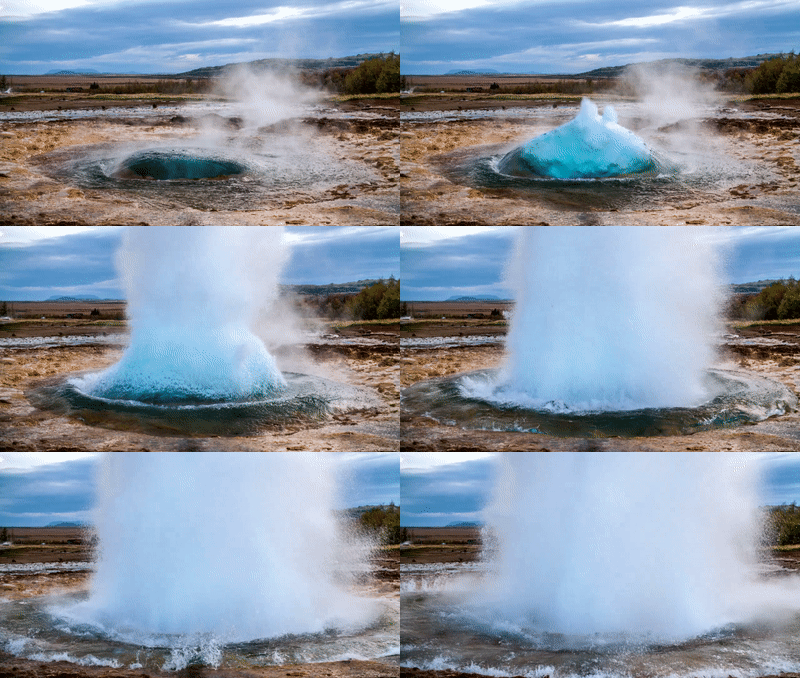
A 555°F Geothermal Well in Utah Could Make 24/7 Clean Power Real
Hotter Rock, Faster Drilling, and a Clearer Path to Always-on Clean Energy Geothermal Just Dropped a Stat Grid Planners Can’t Ignore Every once in a while, a single number cuts through the noise and forces the grid conversation to get real. That just happened in Utah. Fervo says it confirmed a geothermal resource above 555°F, and it drilled the appraisal well in under 11 days.[1] On the surface, that sounds like an impressive engineering milestone. In practice, it’s a potenti
5 min read

The Plot Twist Nobody Was Ready For: Amazon Just Outbid a Utility for a Mega Solar Project
Why a $1 Million Bid Difference Should Worry Every Energy Leader Utilities Are No longer the Only Serious Buyers of Clean Capacity Puget Sound Energy (PSE), a utility in the Pacific Northwest, bid $82 million for a massive solar-plus-storage project in Oregon. Amazon bid $83 million and won. In an $82–$83 million auction, $1 million can look like noise. It isn’t. It’s proof that the buyer pool has changed, and utilities are bidding against companies with urgent load growth an
5 min read

Google’s Grid Warning: Why Transmission Is the Real Threat to U.S. Grid Reliability.
AI data centers are exposing the quiet bottleneck utilities can’t outrun: the wires, the queues, and the legacy systems behind them. Transmission Explained: The Grid’s Highways Most people talk about the grid like it’s one thing. It isn’t. It’s three big layers that do three different jobs. Generation is where electricity is made (power plants, wind, solar, batteries). Transmission is how that electricity moves long distances (the high-voltage “backbone”). And lastly, distrib
5 min read

A Modular Data Center Strategy Built for Tornado Alley
How Tamazari helped Rural Electric Co-ops Deploy 59+ “Mini Data Centers” in 6 Months SUMMARY Between 2010 and 2017, Tamazari personnel helped KAMO Power and its member cooperatives stand up a practical answer to a very modern problem: “How do we run a smarter, more resilient grid without building traditional data centers everywhere?” The team deployed 59+ modular computing facilities across rural Oklahoma and Missouri using a mix of containerized data centers, GFRC prefabrica
4 min read

From Data Chaos to Grid Clarity: GIS Load Forecasting for Smarter Distribution System Planning
How Tamazari Helped 9+ Utilities Use LoadSEER to Pinpoint Load Hotspots and Plan Upgrades Ahead of Electrification SUMMARY Tamazari led project management for a multi-utility implementation program of LoadSEER, a spatial load forecasting platform from Integral Analytics. This tool helps planners predict where electric demand will grow and by how much. Across 9+ major utilities, we converted complex data environments into actionable, map-based forecasting insights. These insig
4 min read
bottom of page